

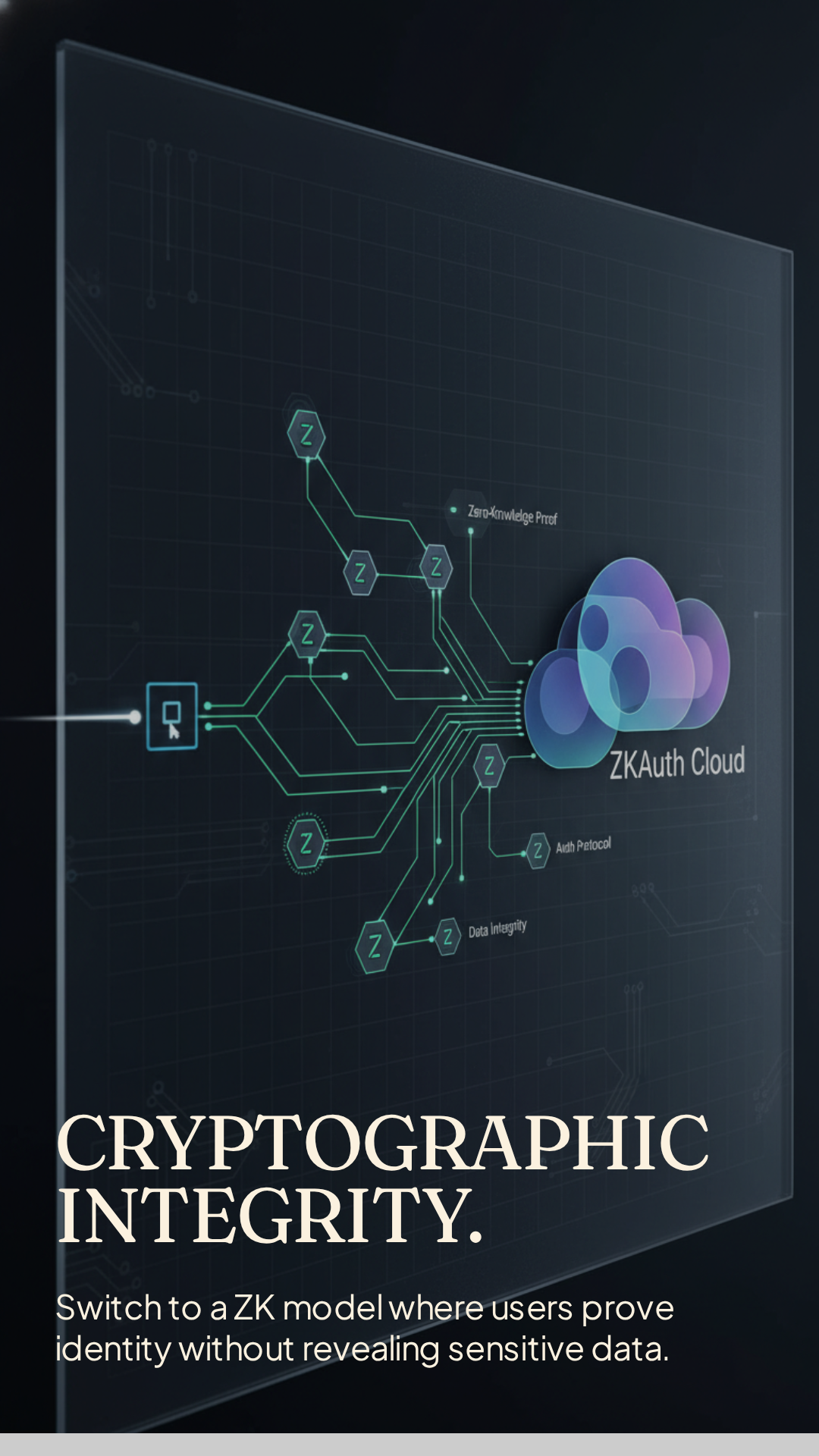
Integration drift creates security bugs
Teams often ship OAuth flows with inconsistent redirect validation, weak state handling, or frontend token exchange shortcuts.
ZKAuth provides a production OAuth Authorization Code integration surface with PKCE, backend token exchange, and JWKS-based verification so teams can ship secure login without guessing protocol boundaries.
The implementation path is explicit: authorize in browser, exchange code in backend, verify JWT through JWKS, then map `sub` into your local user/session model.
The public guide mirrors current backend behavior so teams can avoid fragile assumptions and implement a reproducible secure flow from day one.
Teams often ship OAuth flows with inconsistent redirect validation, weak state handling, or frontend token exchange shortcuts.
Relying on non-guaranteed token fields like username/email leads to brittle account binding and rollout regressions.
Depending on unavailable userinfo/refresh token capabilities introduces hidden coupling and delayed release risk.
Security posture comes from deterministic contracts: strict redirect matching, state validation, PKCE where required, backend-only code exchange, and claim validation.
Frontend sends exact redirect_uri, high-entropy state, and PKCE parameters for public clients.
Authorization code exchange happens server-to-server with client credentials and optional code_verifier.
Client backend verifies RS256 signatures through JWKS and validates issuer, audience, and expiry claims.
Applications bind only the `sub` claim to local users and maintain authorization logic in their own domain.
These implementation tracks map directly to real delivery teams: frontend auth redirects, backend token handling, and security validation gates in application infrastructure.
Launch app registration through admin-managed or self-service provisioning with explicit credential outputs.
Centralize token exchange and claim validation in secure services instead of browser-facing code.
Audit flow contracts where state, redirect URI matching, PKCE, and JWT verification are unambiguous.
Adopt the flow incrementally while keeping existing authorization and local session semantics intact.
No. The documented flow is OAuth Authorization Code. ZKAuth provides the identity authorization surface while your app keeps local session and authorization ownership.
Use `sub` as the stable local identity anchor. Validate RS256 signature and enforce `iss`, `aud`, and `exp` before creating an app session.
Only in backend services. Frontend code should redirect for authorization but must not call the token endpoint with confidential credentials.
Assume token exchange currently requires `client_secret`, and treat refresh token and userinfo-driven flows as unavailable until explicitly documented.